

A 5-year record review, a clinical case, and a path forward
A new peer-reviewed study is out in the June 2026 issue of Neurosurgery Practice, the clinical journal published by Wolters Kluwer on behalf of the Congress of Neurological Surgeons. Read the paper here (DOI: 10.1227/neuprac.0000000000000234).
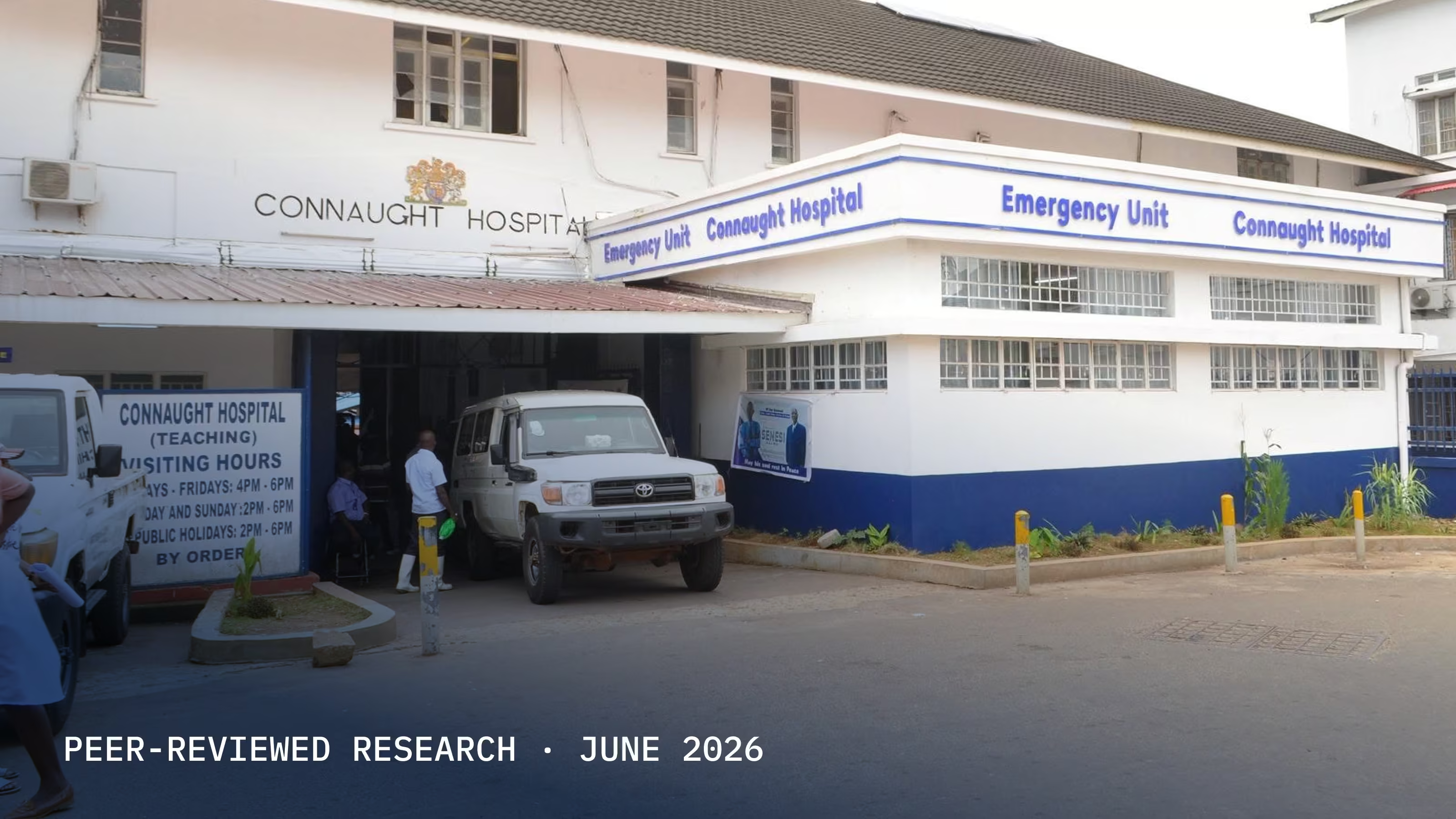
The paper — Stroke in Sierra Leone: Insights From a Retrospective Review to Support the Development of a Neurosurgical Department in the Country — pulls together five years of clinical records from Connaught Hospital in Freetown, Sierra Leone's only public tertiary referral hospital for surgery, serving a catchment area of more than five million people.
It is, as far as we are aware, one of the largest single-hospital stroke datasets ever published from Sierra Leone. And it makes the data case for the work that has been underway on the ground there since 2021.
The research was funded by the Mission:BRAIN Foundation's Lisa Hannegan Humanitarian International Neuroscience Scholarship, awarded to Dr. Megan E. H. Still, who was the senior author on the paper and led the data analysis and manuscript composition.
What the team found
The team reviewed every paper chart in the records department, morgue, accidents and emergency department, and outpatient clinics at Connaught Hospital for patients who presented with neurological or neurosurgical conditions between January 2019 and December 2023. That review covered 2,992 patients. Of those, 1,297 — roughly 43% — were diagnosed with stroke or stroke-like symptoms.
Some of what stood out:
The patients were young. The mean age was 57.8 years, and almost 12% were under 40. That is meaningfully younger than stroke populations in high-income countries.
Hypertension was almost universal among those affected. 68.6% of stroke patients had a prior diagnosis of hypertension. Diabetes was documented in 8.8%, tobacco use in 0.7%, and a known prior stroke in 4.6%.
Most patients arrived without prior care. 72.3% received no medical care before reaching Connaught. Most lived within 5 km of the hospital. Most got there in private vehicles, despite ambulances existing in the city.
Imaging was a barrier. A CT scan was ordered for 89% of patients. Only half (50.8%) of those scans were ever completed. MRI was ordered for fewer than 2% of patients, and only 7 MRI scans were actually completed across the entire 5-year cohort.
One in three patients died in the hospital. In-hospital mortality was 32.9%.
Almost no one came back. Only 6.5% of stroke patients returned for follow-up at Connaught's outpatient clinic — the gap that defines post-stroke recovery in a setting without rehabilitation infrastructure.
The full paper goes deeper on the patterns — triage findings, time-to-presentation distributions, length of stay, GCS on admission and discharge, and the diagnostic limitations that come with reviewing paper charts in a setting where digital records and confirmatory imaging are not the norm.
Why this paper matters
Reliable stroke data from sub-Saharan Africa are scarce. The paper makes that point directly, citing the field literature: most stroke research originates in high-income countries, while the regions with the largest projected stroke burden — including sub-Saharan Africa — are the most underrepresented in the evidence base. By 2030, stroke-related disability-adjusted life years in low- and middle-income countries are projected to exceed those of tuberculosis and malaria combined.
That is the gap this paper fills. A 5-year, 1,297-patient retrospective from Sierra Leone's largest public referral hospital gives clinicians, policymakers, and global health funders something they did not have before: a clear, locally-grounded picture of who is presenting with stroke, what risk factors they carry, what care they receive, and what outcomes look like in a system that — until very recently — had no neurosurgeon.
The paper's conclusion connects directly to the work Mission:BRAIN, our Sierra Leone partners, and Dr. Alieu Kamara have been building on the ground since 2023. From the paper itself:
“Stroke care will be incomplete without adequate evaluation and management by trained neurologists and neurosurgeons. Therefore, these data underscore the urgency of the ongoing imperative work to support the development of the first neurosurgery department in the country at Connaught Hospital.”
That sentence is, in clinical-journal terms, a thesis. The data justifies the program. The program is happening.
The people behind the paper
This is a 19-author paper, and the structure of the byline tells the story of how it came together.
Co-first authors are Dr. Ahmed Sankoh and Dr. Amadu Sall, both Sierra Leonean clinicians at Connaught Hospital. Twelve other Sierra Leonean clinicians from the Connaught team contributed to data collection: Drs. Alusine Barrie, Alhassan Barrie, Alpha Mahmud Bah, Idrissa Korie Turay, Francylda M. A. C. Cummings-John, Salamatu Bah, Emmanuel Chukwunonso Egwuonwu, Esther Ugochi Peters, Abubakarr Kamara, Abdul Kalokoh, Hamza Mansaray, and Andrew Sannoh.
The international team supporting the work included Dr. Megan E. H. Still (senior author, recipient of the Lisa Hannegan Scholarship, manuscript lead), Dr. Alfredo Quinones-Hinojosa (Mayo Clinic Florida), Dr. Kehinde Sunday Oluwadiya (acting Chief Medical Director of the University of Sierra Leone Teaching Hospitals Complex), Dr. Mustapha S. Kabba (Deputy Chief Medical Officer, Sierra Leone Ministry of Health), and April Sabangan, MPH, CEO of Mission:BRAIN.
The acknowledgments section names additional people whose support made the work possible: Dr. Sonia Spencer, Dr. Fatu Conteh, Dr. Kee Park, Dr. Walt Johnson, Dr. Tarik Kahn, and Dr. Aparna Nair-Kanneganti.
To the team in Freetown who reviewed every paper chart by hand, to the international partners who supported the analysis and manuscript through to publication, and to everyone whose name appears here or in the acknowledgments — thank you. This is your work, and it is going to help patients you will never meet.
What this unlocks
A peer-reviewed publication does what experience alone cannot. It moves data into the broader medical literature, where ministries of health, global health funders, and other countries facing similar gaps can evaluate the case on its own terms.
For Sierra Leone, this paper strengthens the evidence base for the continued expansion of neurosurgical care at Connaught Hospital — the very program our team has been supporting since 2023, the program Dr. Kamara launched in January 2025, and the program that performed Sierra Leone's first spine surgery in May 2025.
For the broader field, it adds a substantial, locally-led dataset to an evidence base that has historically been thin on data from sub-Saharan Africa. Other countries in the region facing similar stroke burdens and similar resource gaps now have a published reference point to build from.
And for the donors and supporters who funded the Lisa Hannegan Scholarship: this paper is, in the most direct possible sense, what your support paid for. A peer-reviewed publication, in a respected clinical journal, that makes the data case for a neurosurgery department in a country that did not have one a year ago.
What comes next
The team continues. The Connaught Hospital neurosurgery service continues. The Sababu fund continues. The 24 nurses who have completed neurotrauma certification continue training the next group. The Sierra Leone Mission:BRAIN Chapter continues building infrastructure for sustainable, locally-led care.
The next follow-up study from the team will look at how the comprehensive stroke unit introduced at Connaught in early 2023 has affected stroke diagnosis, inpatient care, and outcomes since implementation.
There is more work to do. There always is. But this paper is a meaningful step — a clinical thesis, in print, built by a team led by Sierra Leonean clinicians and supported by partners around the world.
If you have not yet read the earlier posts in this thread, see Sierra Leone's First Neurosurgeries: Made Possible through Local Collaboration and Mission:Brain Featured on NPR: Expanding Access to Neurosurgery in Sierra Leone.
If you would like to support the continued work — funding surgeries, training nurses, and helping the program reach self-sufficiency — please give today.
Citation: Sankoh A, Sall A, Barrie A, et al. Stroke in Sierra Leone: Insights From a Retrospective Review to Support the Development of a Neurosurgical Department in the Country. Neurosurgery Practice. 2026;7(3):e000234. doi:10.1227/neuprac.0000000000000234


